
Make a Giant Mess
The reason for Ikigai, the end of being a "chill host," translating strife with a central image, speculating the history of a single raisin, and the mess of Margaret Mead

Yesterday, I participated in an Ikigai workshop led by artist Erica Qualy. Ikigai is a Japanese concept derived from Okinawan culture and popularized by Mieko Kamiya, known as the “mother of Ikigai.”
It means “reason for being.” Simple, yet so mind-boggling with how to narrow down your life’s purposes.
Erica handed out a beautifully illustrated multi-Venn diagram with four main circles to fill in: what you love, what you are good at, what you can be paid for, and what the world needs.
In overlapping circles: your passion, your mission, your profession, your vocation.
After we filled out each circle, we shared things we had written. I heard things like wanting to be a death doula, a passion for coding apps to help navigate public transit, wanting to work on a barge, the desire to help queer youth of color, wanting to be a professional mediator, and wanting to showcase art from all over the world to bridge the gap between cultures.
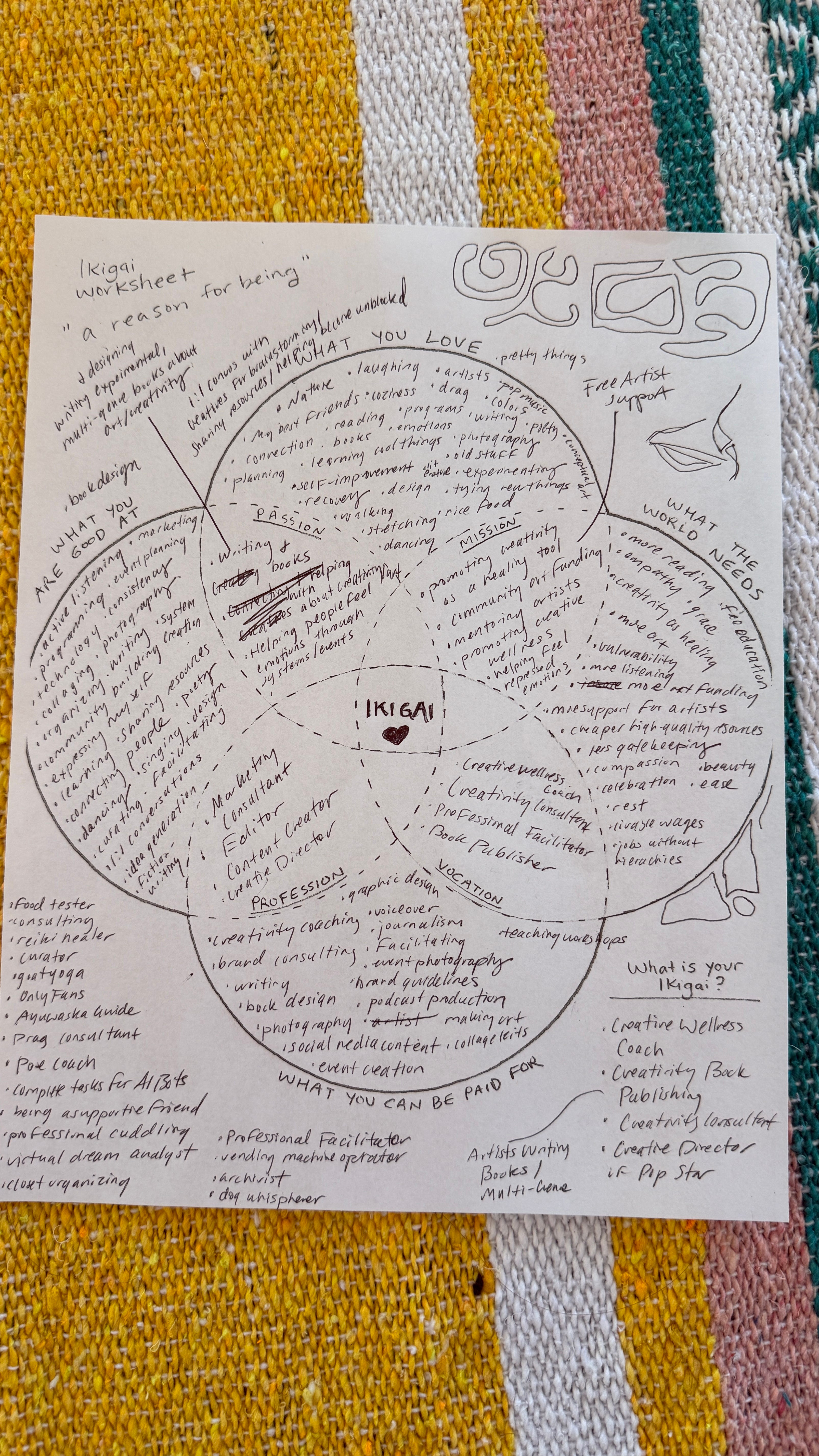
The most magical part—after we shared our Ikigais, the floor was open to share ideas on how we could all help each other bring our “reason for being” to fruition. One person knew someone who had a death doula; they would get them in contact with each other. Event ideas were thrown out in abundance. Spaces were offered up.
The energy of the 13 or so participants was buzzing, so much so that we created a group chat called “Ikigroup” to continue helping each other fulfill our purpose.
This newsletter is a smaller part of one of my Ikigais. One of my missions is to promote creative wellness and to keep creatives connected to their creative energy—especially through writing, my first intrinsic passion I was born with. I’ve thought a lot about my purpose over the last few years. Yesterday’s process just helped me narrow it down even more.
My Ikigais: Creative Energy Coach, Creativity Book Publisher, Creativity Consultant, and Creative Director for Artists (mainly pop stars).
The more I learn about creative wellness, the more I am on my path. I can surrender to knowing it’s all gonna work out if I keep my eye on these north stars.
In this week’s Creative Wellness Research Log Entry, I will talk about:
Why you should stop being a “chill host” (Community)
Creating art as a mirror of what you’re going through in life (Craft)
Feeling empathy for raisins through a meditation (Clarity)
Stories about bodies of knowledge as told by Gloria Steinem (Condition)
Stop being a “chill host”
Code: COMMUNITY
Currently reading — The Art of Gathering by Priya Parker
Priya Parker does not hold back in her book, The Art of Gathering. As a professional facilitator, she’s worked across hundreds of sectors and gathering types in order to bring back meaning and flow to gatherings to make them suck less. Because let’s be honest, some gatherings suck.
This week I read her treatise on how being a “chill host” is “selfishness disguised as kindness.” Oof. Hard pill to swallow for those of us (me) who think being chill makes us more likable and let’s us off the hook for responsibilities.
Parker mentions an essay by Alana Massey called “Against Chill” that defines being chill as a “laid-back attitude, an absence of neurosis” that “presides over the funeral of reasonable expectations.” Double oof.
I don’t like to tell people what to do. I think that comes from my distrust of authority. I don’t like to be told what to do. A lot of my events are centered around the idea of free exploration, but I do think I could benefit from being less fearful of being a more active host.
Parker says:
The chill approach to hosting is all too often about hosts attempting to wriggle out of the burden of hosting. In gatherings, once your guests have chosen to come into your kingdom, they want to be governed—gently, respectfully, and well. When you fail to govern, you may be elevating how you want them to perceive you over how you want the gathering to go for them. Often, chill is you caring about you masquerading as you caring about them.
She brings up the idea of “generous authority.” It’s a way to save your guests from the “chaos and anxiety” that can be stirred up.
One simple way to practice generous authority: connecting guests to one another. You can make people more comfortable and connect people based on their common interests.
Creative Experiment to Try:
Host a dinner party or craft circle with people who wouldn’t typically meet together. Facilitate an activity where people write three passions on a notecard in order to find common interests and match guests together.
Translating life lessons through art
Code: CRAFT
Currently witnessing — “How to Capture the Process of Surrender on Film” — An Interview with Rodney Ellis
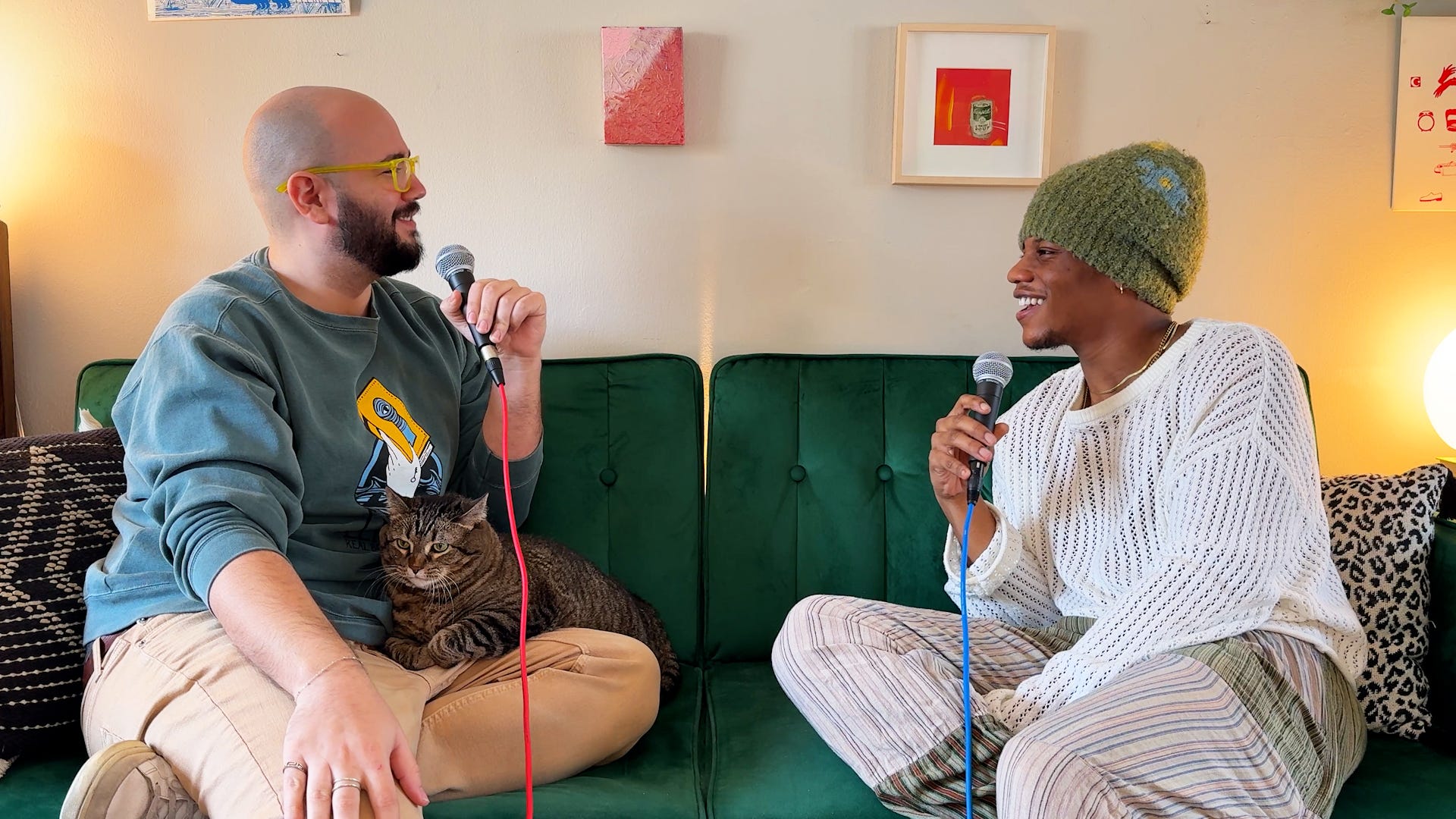
I had the pleasure to interview photographer and filmmaker Rodney Ellis on the Like Really Creative Show. I met through Rodney through Ugly Art Co., an art collective we are both part of. I was drawn to Rodney’s gritty slice-of-life work, and as I got to talk to him, I found out more about what drives his creative process.
Rodney is the first to admit that he has not had any technical training. That’s my favorite kind of artist. Rodney learns through trial and error, soaking up every little detail from films he watches, letting his subjects in his films and photography take the lead on how they express themselves. He’s always in the process of trying to figure out what his signature “shot” is as a filmmaker. For example: chase scene shots, trunk scenes, crowd scenes.
His work is a distillation and metaphor for what he’s currently going through. In his film “God’s Son,” he was inspired by what his mother always tells him: “Sometime’s you just gotta release.”
Rodney says:
It was this surrendering thing. This was the whole theme of [God’s Son]. If you don’t surrender, eventually you’re going to die on your own sword. And that’s what happened to the character at the end. That was something I was learning in my own life at that time. And what’s what I learned what art is. I’m still learning art.
Creative Experiment to Try:
Think of a recent hardship or life lesson you are struggling to learn. Translate your experience into a central image, like Rodney’s “sword.” Create a piece of art with this image.
Speculating the history of raisins
Code: CLARITY
Currently doing — Raisin Meditation by Jon Palouse
I never thought I’d be feeling empathy over a raisin, tearing up over its history.
In this meditation by mindfulness teacher Jon Palouse, you are asked to mindfully eat a raisin. Very slowly. Very very slowly. For 10 minutes. You swish it around in your mouth, absorbing the texture and flavor
What I did not expect was Palouse to ask us to delve into the history of this raisin. Where did this raisin come from? What kind of soil was it in? How did this raisin get to you, in this exact moment? How does this raisin connect to every thing in the entire universe?
Palouse says:
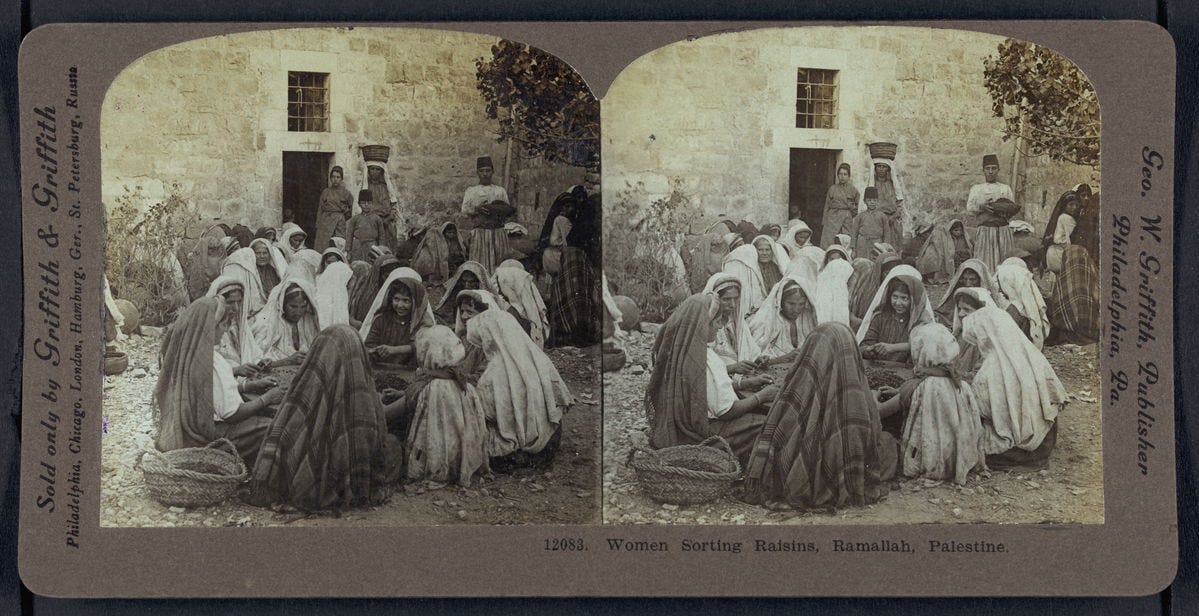
The raisin didn’t always exist as a raisin. It used to be a grape. And that grape needed certain things in order for it to survive and grow…It got picked by a laborer, who took it and put it maybe in some cardboard box, and left it out to dry. And then it had to be put into a container that you found at the grocery store. There’s so much that went in to getting this raisin to you here, now—the grocery store, the clerk, who you purchased it from when you got it off the shelf, and now here it is, in your hand, this one small raisin. Everything is in this raisin. The sun, the sky, the rain. In a way, it’s not separate from those things.”
He goes on to say that one of the lessons to gain from mindfulness is to “discover that everything is connected.”
Damn. We are ALL the raisin.
Creative Experiment to Try:
Find a prized possession of yours, something gifted to you or you found. Examine this object closely. Get some paper and write all the things that went into you having this item in your possession. Speculate the item’s history.
The mess of Margaret Mead
Code: CONDITION
Currently reading — “Revolution from Within: A Book of Self-Esteem” by Gloria Steinem
It’s hard to describe how life-changing the book “Revolutions from Within” by Gloria Steinem is to me. It’s changed my whole worldview. The book—Gloria Steinem’s only self-help book—helps us to untangle ourselves from the patriarchal drive that wrings out our self-esteem.
In the chapter titled “Bodies of Knowledge,” Steinem investigates how the policing of our bodies and the miseducation of the mind-body connection stem from old ideas that keep us trapped from fully engaging with this connection, how it’s an energetic exchange that is undervalued in Western dualism thought.
She explores ways to deepen this connection through breath, touch, sexuality, physical imagery, and moving in space.
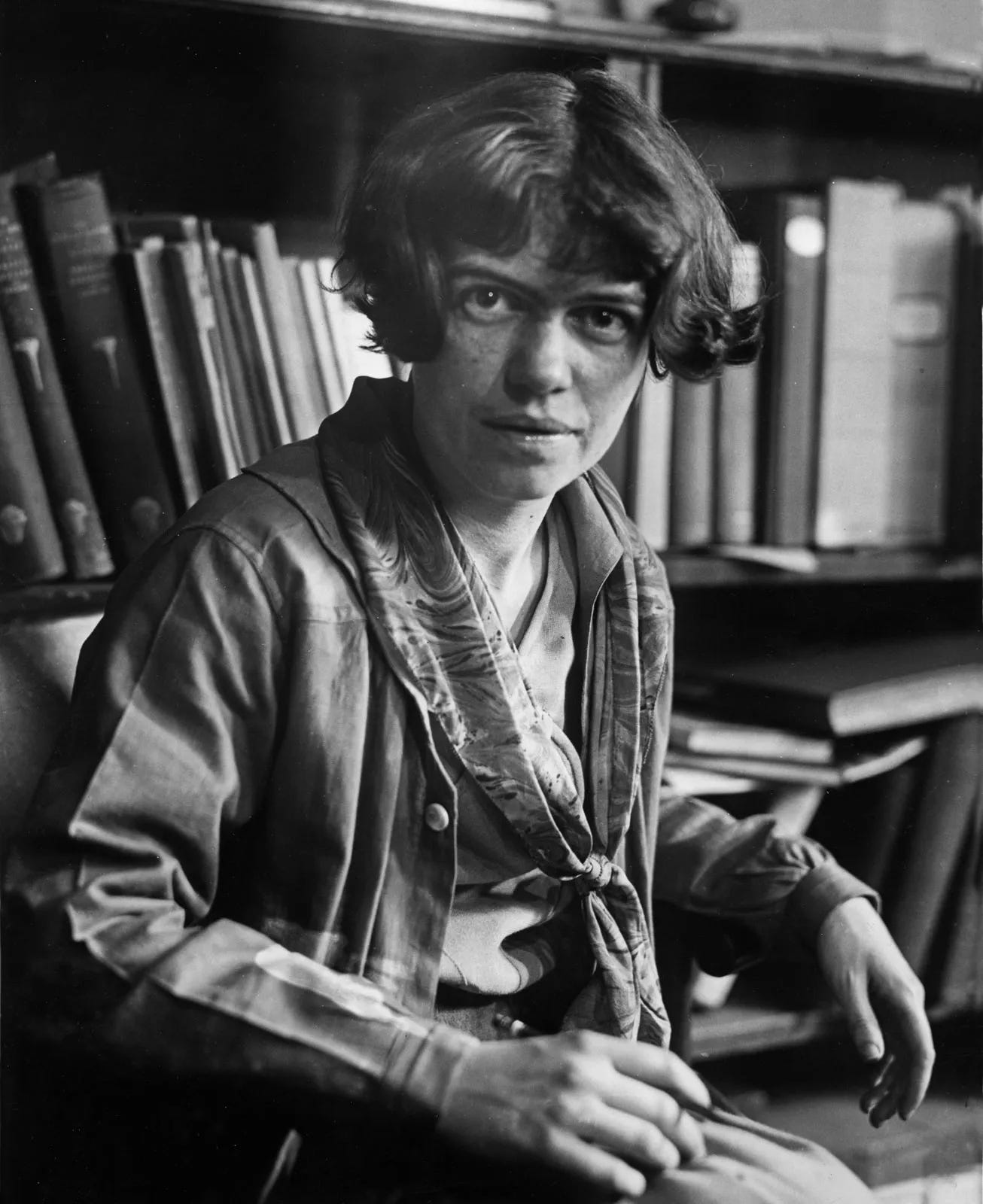
Steinem brings up four parables of how four individuals were able to honor the wisdom of their bodies—three of them grew up not being allowed or taught to honor their body and one—anthropologist Margaret Mead—who had the privilege of being fully embodied from childhood.
In the first parable, she details a story about a writer, who—plot twist—is Ronald Reagan’s daughter who did not feel allowed to explore physical strength.
Steinem says, “For women to enjoy physical strength is a collective revolution. For Patti, overcoming the feelings of weakness and body-fear that had put her at such a disadvantage as a little girl with a punishing mother and a distant father was the beginning of inner strength, too.”
Once Patti was fully embodied, her writing practice soared.
After showing examples of limitations, Steinem examines—through Margaret Mead—the possibilities of what can happen if individuals are allowed a “whole-body, all-five-senses upbringing.”
During childhood, Mead was encouraged by everyone around her to “explore the world around her in every way she or they could imagine.”
She says:
Diverse toys and physical challenges, colors and textures, music, art, and perhaps most important, permission to get dirty and make a mess—all these were part of Margaret’s preschool life.
Margaret’s mind-body connection gave her deep insights into the human condition that led to groundbreaking work in anthropology from child-rearing to the relationship between culture and personality. Her friend Jean Houston said of her, “Dualisms were discouraged; she was trained to accept the unity of mind and body, thinking and feeling.”
While we obviously can’t go back in time and change the limits from our childhood, we have the present moment to honor that mind-body connection by making a giant mess.
Creative Experiment to Try:
Make a giant mess. Get outside, lay a tarp down, and get some tactile items: paint, clay, dirt, charcoal, fabric. Get a surface to make a mess on. Play energetic music and move intuitively, switching between tactile items. Fling stuff around. Go wild.
👏👏👏